Apparently today is the day to take a gamble, to step outside of your comfort zone, and as in No Limit Texas Hold 'em, if you go all in you can either win it all or lose it all.
But people say "You can't have it all", so if your choices are all or nothing, but you can't have it all then does that mean that you can only have nothing? First of all, who says you can't have it all and why can't you? There's plenty of almost everything to go around so let's assume that it is possible to have it all. But now let's look at all or nothing. Who says you can have all or nothing? It's one of many false dichotomies that we have to deal with in our society because most of society has a scarcity attitude. Instead of saying either/or, why can't we say both/and. In some cases, like this one, it's not really possible since these are opposites but either all or nothing are not the only possible choices...how about some?
For better or for worse? How about for mediocre? Hot or cold? How about warm? Rich or poor? How about middle class? Fast or slow? How about half-fast? (Pun intended). Those things are opposites, so if you have both at the same time it's more of a compromise. But how about some other false dichotomies like "I'd rather be happy than rich"? Why can't you be both happy and rich? And why are the people saying it neither rich nor happy? Apparently being broke doesn't make you happy either. Or what about Ginger or Mary Ann? To find out more about this false dichotomy check out this blog post from last October.
Some of the best things in life are made of the both/and idea. How about peanut butter and jelly? Sure, you could have either peanut butter or jelly but life is so much better when you have both peanut butter and jelly. And how about bacon and eggs? I can just see sitting down for breakfast and being told that you can have either bacon or eggs, because you can't have it all.
So, remember that it's possible to have it all. And some is better than none. But celebrate this day in the spirit it was intended and go out and give it your best shot.
You've invited someone to take a look at your business opportunity, but they don't have the time or they don't have the money. Or maybe they need to talk to their spouse. Or maybe the planets are out of alignment. Maybe you've invited them to an event and in addition to the above excuses, you also hear it's too far. It really doesn't matter what their excuse is because any excuse will do...for whatever reason they don't want to do what you're asking them to do, so they come up with an excuse.
Occasionally their excuse is valid such as the Facebook friend I invited to an event next month but she'll be out of the country, but often it's just fear of the unknown.
Is there anything you can do? I would suggest that you make sure you give them the information they need to be able to answer two questions for themselves...Does it work? And can I do it? Usually if they can answer those two questions, your prospect will be able to make their decision. But be sure that you don't give them too much information because if they feel confused or inundated with information they'll make an excuse.
I still use excuses from time to time...usually I can't afford it. But if something is important to you, you will find the way. So, I work at finding the way to afford it. Because if you say "I can't afford it", you can't but if you say "How can I afford it?" you'll find a way.
If somebody makes an excuse, don't try to force them to make a decision, because it will probably be no if you do. Instead, just let them go but keep in touch with them and periodically ask them again. Who knows? Maybe the next time or the time after that, they'll be ready to join you.
I attended the Promptings Academy event this past weekend, so I thought it was a good time to update this post.
The event was broken up into 2 sessions; the morning session was about promptings which was the basis for the old Treat 'em Right seminars that SendOutCards used to do; and the afternoon session was about the 5 Habits. If you want to find out more about promptings, read the book "Promptings" by SOC founder and CEO, Kody Bateman.
The morning session was definitely aimed at both distributors and non-distributors. The theme was to find out who you are and to give the best version of yourself away to others. The afternoon session was aimed primarily at distributors, although habits 1 and 5 could apply to anyone. Everyone, distributors and non-distributors alike, should be sending cards every day whether for personal or business. And everyone should be continually working on their personal development. And even if you're not a distributor there are probably people you know who should be using SendOutCards...if you work on the other habits you can show them how easy it is to send a card and gift from their phone.
All of the habits require becoming a level 4 at something. I wrote about this in a previous blog post.
Habit 1: Become a Level 4 Card Sender
Send cards on a daily basis, without having to think about it
Habit 2: Become a Level 4 User of your Smartphone
Be able to use the SOC smartphone app without having to think about it
Habit 3: Become a Level 4 User of the APA Recruiting System
Be able to Ask - Present - Ask without having to think about it
Habit 4: Become a Level 4 With Training the 5 Habits
Become so familiar with the 5 habits that you can share them with others without having to think about it
Habit 5: Become a Level 4 With Personal Development
Whether or not you're in SendOutCards, everyone should work on personal development every day without having to think about it
How many of us sit at a desk all day, whether in Corporate America or in our own offices? And how about the daily commute? I find myself sitting pretty much from the time I get up until the time I go to bed. So, what's a guy (or gal) supposed to do about it?
For most of human history, work has been a physically demanding
activity. Our cavemen ancestors chased down mastodons and hurled spears
into their tough, but tasty flesh, American homesteaders tamed the
wilderness into productive farms with nothing but grit and sweat, and
just 60 years ago, the majority of men in America flexed their muscles
on factory floors or construction sites.
Fast-forward to today.
Instead of feeding ourselves by the sweat of our brows, most of us
just slouch in a chair all day in a climate-controlled building while we
push buttons and send documents through the ether. And the sitting
doesn’t end after work. When we get home, we plop down in front of the
TV to watch reality shows of men performing the kind of virile,
physical, and often dirty work we fantasize about doing while answering
emails in our cubicle.
Man’s transition from callused-handed, blue-collared laborer to
soft-handed, white-collared desk jockey has done a number on us
physically and mentally. Not only have our desk jobs made us weak,
flabby, and stiff, sedentary work is sapping the very hormone that makes a man a man: testosterone.
What’s more, all this sitting is slowly eating away at our life meters. One study
showed that men who sit for more than six hours of their leisure time
each day had a 20% higher death rate than those who sat for three hours
or less. For the desk jockey, death comes wrapped in a Successories
Poster and waving a USB drive.
“Ah-ha!” you say. “I work out out like a beast in the gym every day and have a physique that rivals Eugen Sandow’s. My hour-long, herculean effort counteracts all the sitting and slouching I do at work!”
Sorry to break it to you Mac, but your visits to the gym aren’t doing
much to mitigate the damage that accumulates from all that desk
jockeying.
Studies
have shown that consistent, vigorous workouts don’t do much to offset
the damage we do to our bodies by sitting down all day at our cushy
Dilbert-esque jobs.
So what’s a modern man to do?
If you want to live to see your future grandkids and maintain your
manly physique and sense of well-being, you’re going to need to stay
active throughout the day.
That can be tough when you’re chained to a desk filling out TPS
reports or attending unproductive brainstorming sessions on how to build
more “synergy.” But with a little creativity, and a bit of gusto (along
with a thick skin about what other people think of you), you can easily
find ways to sneak some exercise into your work routine and flip the Physicality Switch of Manliness.
Below we offer a few simple suggestions on how to stay active all day
even if you’re a white-collared desk jockey. Incorporate them into your
schedule and you’ll find yourself with hips as limber as an Olympic
powerlifter and more energy than you had as a teenager.
1. Make Getting to Your Office a Challenge
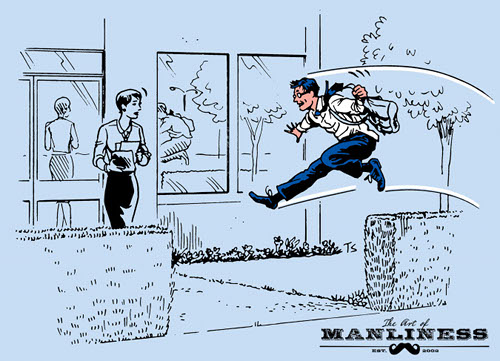
Look for ways to make getting to work and into the corporate cave a
challenge. Biking to work is of course ideal. If you have to drive, park
at the far end of the lot so you have to walk further to the building,
carry a giant Saddleback Briefcase (those
suckers are heavy) filled with your laptop and small boulders, and
hurdle over small hedges as you make your way to the door. For extra
challenge, throw in some parkour and scale the walls like AoM reader Jeremiah Jacques:
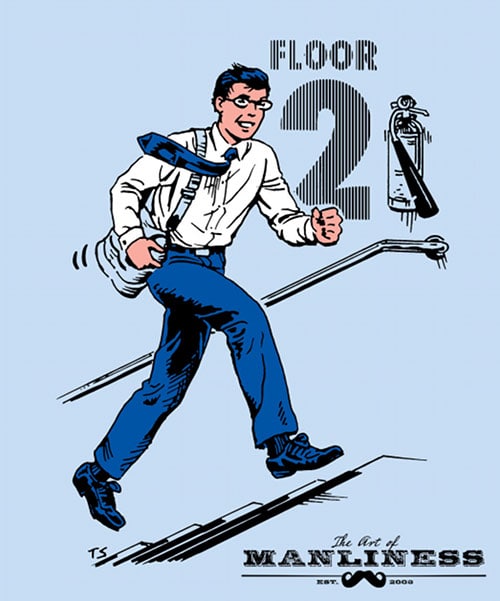
2. Take the Stairs. While You’re At It, Run Up Them
Instead of using the elevator to move between floors, take the
stairs. Start off walking, but work your way up to a full out sprint.
Don’t worry about looking like a crazy person. Most stairs in office
buildings are hidden away as fire escapes and hardly anyone uses them.
Once you reach your floor, pause outside the door to catch your breath,
straighten your tie, and mop your forehead with a handkerchief. You just literally leveled up on your high intensity training!
3. Get a Standing Desk
One of the best things you can do to mitigate the health-sapping
effects of your desk jockey job is to get a standing desk. The drain on
your weight and health, including hip and back stiffness and pain, that
comes from sitting down all day will disappear. While you might not be
able to convince your boss to spring for an expensive hydraulic-powered
standing desk (though I’d at least try lobbying him for it), you can
jerry-rig your own standing desk in various ways (search Flickr.com for “standing desk” for ideas).
To learn more about the benefits of standing to work (and its manly history), check out this article from the archives on standing desks.
4. Maintain Good Posture Throughout the Day
If you want to avoid the Quasimodo shoulder slump that
seems prevalent among desk jockeys, make the effort to practice good
posture throughout the day. Yes, it’s hard and tiring at first, but the
struggle is well worth it. Practicing good posture while sitting and
standing can reduce tension in your neck, shoulders, and back, improve
organ function, and strengthen your all-important core.
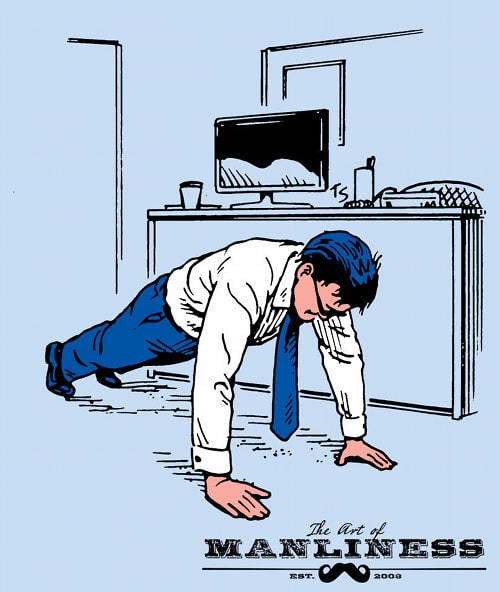
5. Do 10 Push-Ups and 10 Squats Every Time You Take a Bathroom/Coffee Break
When I clerked at a law firm here in town, my office sat adjacent to
that of the firm’s sole surviving founding partner. He was one of the
coolest old guys I’ve ever met. He was sort of like Teddy Roosevelt in a
lot of ways. The walls of his office were covered with stuffed and
mounted wildlife from his many hunts; dropping memos off in his office
was like stepping into the Museum of Natural History. Despite being
nearly 80 years old, this old partner was spry as a young buck. I asked
him his secret to his youthful vigor at lunch one day, and this is what
he said:
“Maintain a sense of humor. You need it in the legal business. And do
lots of push-ups while you’re at work. I always do ten anytime I get up
from my chair.”
And he did.
Every now and then, when I walked by his office, I’d see a short,
bald old man on the floor, cranking out push-ups in his waistcoat.
That little old man inspired me. I started a similar routine that
summer at the law firm. Anytime I got up from my chair, I’d do 10
push-ups. I also added 10 bodyweight squats for good measure. The
result? I felt more energized and less stiff. More importantly, I
started losing some of the summer intern lunch chub that I had gained
over the summer.
Stay active throughout the day by incorporating a similar routine.
6. Get Up and Walk Outside for 15 Minutes Every 45 Minutes
I’ve noticed that I’m more productive when I work in shorter
increments and take frequent, small breaks throughout the day than if I
slog through a project in a single sitting. Taking frequent breaks isn’t
only good for your brain, it can also be good for your body, too. To
keep your brain and body running on all six cylinders, use the Pomodoro Technique when you’re working.
Set a timer for 45 minutes and work non-stop. When the 45 minutes are
up, take a break for 15. Instead of surfing the web or chatting with
Mark in HR, go outside and take a leisurely 15 minute stroll (unless of
course you have a job where your boss expects you to be at your desk
every minute). Plain old walking provides a surprising amount of health
and mind benefits such as lowering our resting blood pressure, reducing obesity, and improving our working memory.
Doing your walk outside will also help you activate the Nature Switch of Manliness, which will reduce stress, keep you mentally sharp, and even boost your testosterone.
You can even make your walks productive by holding meetings with
co-workers as you stroll. There’s something about walking and talking
that gets the creative juices flowing. Steve Jobs was famous for his
walking meetings. Instead of sitting at a table in a stuffy conference
room, he’d ask the person he wanted to meet with to take a walk with him
outside. Co-workers would go on to say that those “walking meetings”
were some of the most productive meetings they ever experienced. Jobs
was likely inspired by Aristotle’s peripatetic teaching.
Instead of standing in front of a large group of students to lecture,
Aristotle preferred to walk and talk to his students.
If it worked for Jobs and Aristotle, maybe it will work for you. Even
if you don’t come up with a breakthrough business idea during your
walking meeting, you’re at least staying active.
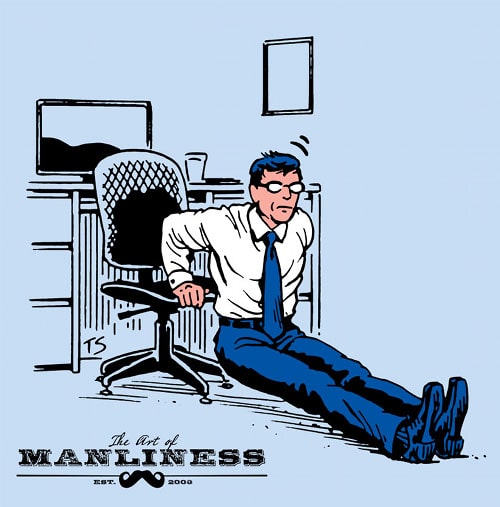
7. Perform 15 Dips When Leaving for and Returning from Lunch
Work those tri’s before and after lunch by cranking out a quick set
of 15 dips when you leave for and return from lunch. Just place your
hands on your chair and walk your feet out in front of you. I like to
keep my legs stretched straight out while I perform the dips. Lower
yourself until your arms form a 90 degree angle and then press up.
Repeat 14 more times.
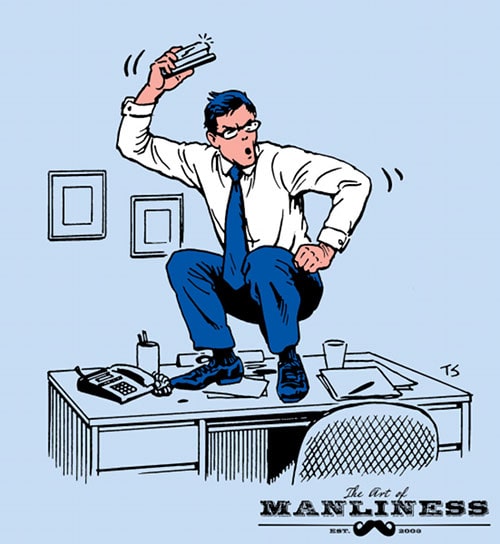
8. Perform 30-Second Grok Squats Throughout the Day
Mark Sisson from Mark’s Daily Apple
introduced me to one of the best exercises to help alleviate the back,
groin, and hip tightness that comes from sitting in a chair all day:
the Grok Squat.
Also known as the Asian Squat or Indigenous Person Squat, the Grok
Squat is a sitting position that you find in cultures that don’t have
sofas or chairs like we do in the West. It’s something you did as a tot,
and have forgotten; our almost two-year-old son, Gus, gets down into
some really amazing Grok Squats all the time.
The Grok Squat is very similar to a catcher’s stance in baseball.
Simply squat down until your butt touches your ankles. Keep your heels
firmly on the ground and back straight. Hold that position for 30
seconds to a minute. You should feel your hamstrings,
quads, Achilles tendons, lower back, and groin gently stretching. If
you’re super stiff, it may take a few days of practice to sink into a
full-on Grok Squat. Keep at it. Your back and hips will thank you.
To avoid the stiffness that comes from sitting and standing all day,
incorporate several short Grok squats into your daily routine. A great
time to do them is right after your 15 minute long walks.
Before you
resume working, simply crouch into a Grok squat and hold it for 30
seconds to a minute.
For added effect, do the Grok Squat on top of your
desk while holding a stapler above your head like that monkey hoisting
the bone at the beginning of 2001: A Space Odyssey. Illustrations by Ted Slampyak


 Posts
Posts