Monday, October 16, 2017

Don't be mean


I'm not talking about mean as in "offensive, selfish, or unaccommodating; nasty; malicious", although it's a good idea to not be those things.

I'm talking about mean in the mathematical sense, as in one of the "measures of central tendency". In this case mean means average. So, don't be average, which is also good adcice.

Mean is what we're referring to when we talk about average, although it's not always the best measure of central tendency. Since we're most familiar with the mean, we'll start our conversation there.

In this example from Laerd Statistics, the mean, or average, is 59:
65 55 89 56 35 14 56 55 87 45 92
Or in order from smallest to largest: 
14 35 45 55 55 56 56 65 87 89 92
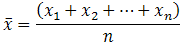
These could be the scores on a math test. To find the mean, you add up all of the values, in this case the total is 649, and divide by the number of vales, in this case 11...649 / 11 = 59. The formula (again from Laerd) is:
The mean (or average) is the most popular and well known measure of central tendency. It can be used with both discrete and continuous data, although its use is most often with continuous data. The mean is equal to the sum of all the values in the data set divided by the number of values in the data set. So, if we have n values in a data set and they have values x1, x2, ..., xn, the sample mean, usually denoted by (pronounced x bar), is:
This formula is usually written in a slightly different manner using the Greek capitol letter, , pronounced "sigma", which means "sum of...":
But the mean only gives you half the answer. We also want to know how spread out the values are from the mean. For example 99, 100 and 101, and 0, 100 and 200 both have a mean of 100...but the values in the second set are more spread out than the first set. The simplest measure of the spread is the range, which is the difference between the highest and lowest values. In the first set, the range is 2 (101 - 99) while the range in the second set is 200 (200 - 0). In the test scores example above, the range is 78 (92 - 14).

The range is ok in simple examples, but a better measure is the standard deviation:

Standard Deviation

The Standard Deviation is a measure of how spread out numbers are.
Its symbol is σ (the greek letter sigma)
The formula is easy: it is the square root of the Variance. So now you ask, "What is the Variance?"

Variance

The Variance is defined as: The average of the squared differences from the Mean.
To calculate the variance follow these steps:

  • Work out the Mean (the simple average of the numbers)
  • Then for each number: subtract the Mean and square the result (the squared difference).
  • Then work out the average of those squared differences.
For our test score example above, the mean is 59, the variance is:

(65-59)^2 + (55-59)^2 + (89-59)^2 + (56-59)^2 + (35-59)^2 + (14-59)^2 + (56-59)^2 + (55-59)^2 + (87-59)^2 + (45-59)^2 + (92-59)^2 / 11 which is 36 + 16 + 900 + 9 + 576 + 2025 + 9 + 16 + 784 + 196 + 1089 / 11 or 5656 / 11 which is 514.181818...the standard deviation is the square root of that or 22.67558.

Now, what can we do with that? Approximately two-thirds of the values (68%) will lie within 1 standard deviation of the mean...95% within 2 sd and almost all (99.7%) will lie within 3 sd.

In our example, 1 standard deviation is 36.32443 to 81.67558, 2 sd is 13.64884 to 104.35116 and 3 sd is -9.02674 to 127.02674. So, about 7 or 8 of our values should lie within 1 sd (45, 55, 55, 56, 56, 65), we have 6. And all of the rest lie within 2 sd...none are outside that range.

If we had 1,000 values we should expect 680 within 1 standard deviation, 950 within 2 sd and 997 within 3 sd (or all but 3).

The mean works well if all of the values are fairly close to each other, but it can be thrown off by outliers, or values that are far away from the others. That's why you'll usually wee median incomes or median home prices. A CEO's income can throw off a salary table or a very expensive home can doo the same thing to home prices. Going back to Laerd:
The mean has one main disadvantage: it is particularly susceptible to the influence of outliers. These are values that are unusual compared to the rest of the data set by being especially small or large in numerical value. For example, consider the wages of staff at a factory below:
Staff 1 2 3 4 5 6 7 8 9 10
Salary 15k 18k 16k 14k 15k 15k 12k 17k 90k 95k
The mean salary for these ten staff is $30.7k. However, inspecting the raw data suggests that this mean value might not be the best way to accurately reflect the typical salary of a worker, as most workers have salaries in the $12k to 18k range. The mean is being skewed by the two large salaries. Therefore, in this situation, we would like to have a better measure of central tendency. As we will find out later, taking the median would be a better measure of central tendency in this situation.
To take the median, the values have to be sorted from lowest to highest:
12k, 14k, 15k, 15k, 15k, 16k, 17k, 18k, 90k, 95k
The median is the middle value which is 15.5k since there are an even number of values, you take the average of the 2 middle values which are 15k and 16k in this example, which makes more sense than the $30.7k mean. Half the values (5) are below the median and half are above it. You can take the inter-quartile range by finding the upper and lower quartiles (which are basically the median of the bottom half of the data and the upper half of the data): since there are 5 values in the bottom and top halves, the quartile is the middle value. The lower quartile is 15k and the upper quartile is 18k. The inter-quartile range (IQR) is 18k - 15k, or 3k. Half of the data values will fall in that range. In our example, half of the values fall between $15k and $18k. If any value falls 1.5 times the IQR above Q3 or below Q1, it is considered an outlier. 1.5 times IQR is 4.5k, so anything below $11.5k or more than $22.5k is an outlier. We can see that our 2 highest values, $90k and $95k are outliers.You can use a box plot to show these values:

The blue box is the middle 50%, the white line is the median, the vertical bar is the lowest value
Last but not least is the mode. The mode shows the "popularity" of something, such as the most popular color of car in the parking lot or the most prevalent color of M&M's in a bag.

When I got to work at 6:45 on a Sunday evening, there were 2 black cars, 2 gray cars, 2 white cars, 1 silver car and 1 blue car (mine). In this case, the data is multi-modal because there are 3 colors with the same value. If there had been one more company car (white), then the mode would have been 3 for the 3 white cars.

I bought a bag of plain M&M's and the color breakdown was as follows:

Brown - 7
Yellow - 12
Red - 6
Orange - 11
Green - 13
Blue - 5.5
           54.5

The mode is 13 which equates to green although yellow and orange are quite close.

There is actually a breakdown of colors in a bag, according to Deal News:
On average, the mix of each variety of M&Ms follows these color percentage breakdown: M&M'S Milk Chocolate: 30% brown, 20% yellow, 20% red, 10% orange, 10% green, and 10% blue. M&M'S Peanut: 20% brown, 20% yellow, 20% blue, and 20% red, 10% orange, and 10% green.

Interesting days


Today - Steve Jobs Day, Department Store Day, Feral Cat Day, Boss' Day, Clean Your Virtual Desktop Day and Dictionary Day

Tomorrow - International Day for the Eradication of Poverty, Wear Something Gaudy Day, Spreadsheet Day, Mulligan Day, Ada Lovelace Day and Playing Card Collection Day

Next Monday - iPod Day, Mole Day, TV Talk Show Host Day and Boston Cream Pie Day

November 16 - Beaujolais Nouveau Day, Social Enterprise Day, Button Day,  Have a Party with Your Bear Day, Fast Food Day and International Day for Tolerance


Saturday, October 14, 2017

Your weekend guide to interesting days

This week


Sunday - Pierogi Day and World Octopus Day

Monday - Columbus Day, Native American Day, World Post Day, Fire Prevention Day, Curious Events Day, Moldy Cheese Day and Beer and Pizza Day

Tuesday - World Mental Health Day, Hug A Drummer Day, Handbag Day, Face Your Fears Day, SHIFT10 Day, World Homeless Day, Cake Decorating Day and World Porridge Day

Wednesday -  Pet Obesity Awareness Day, Emergency Nurses Day, Take Your Parents To Lunch Day and  Coming Out Day

Thursday - Pulled Pork Day, World Arthritis Day, Old Farmers Day and World Sight Day

Yesterday - Train Your Brain Day, World Egg Day, No Bra Day and Vet Nurse Day 

Today - International Top Spinning Day and Be Bald And Free Day

Next week


Tomorrow - World Maths Day, World Students' Day, White Cane Safety Day, Chicken Cacciatore Day and World Toy Camera Day

Monday  - Steve Jobs Day, Department Store Day, Feral Cat Day, Boss' Day, Clean Your Virtual Desktop Day and Dictionary Day

Tuesday - International Day for the Eradication of Poverty, Wear Something Gaudy Day, Spreadsheet Day, Mulligan Day, Ada Lovelace Day and Playing Card Collection Day

Wednesday - Chocolate Cupcake Day, Hagfish Day, Global Dignity Day and No Beard Day

Thursday - Get Smart About Credit Day, Conflict Resolution Day and Evaluate Your Life Day

Friday - Information Overload Day,  International Sloth Day, Waiters Day, Brandied Fruit Day and Suspender's Day

Saturday - Sweetest Day, Apple Day, Count Your Buttons Day and Reptile Awareness Day

Next month


November 8 - Benjamin Banneker Week, X-Ray Day and Cook Something Bold and Pungent Day

November 9 - World Freedom Day and Chaos Never Dies Day

November 10 - Area Code Day and Sesame Street Day

November 11 - Veteran's Day, Pocky Day and Origami Day

November 12 - International Tongue Twister Day, World Quality Day, Fancy Rat & Mouse Day and Pizza With The Works Except Anchovies Day

November 13 - World Kindness Day and World Orphans Day

November 14 - Loosen Up, Lighten Up Day, Operating Room Nurse Day, Pickle Day, World Diabetes Day and Spicy Guacamole Day


Friday, October 13, 2017

The Friday Fishwrap

All the news that's fit to wrap around a dead fish

The week in review


Monday - "Are you sending holiday cards this year?" And why you should. "Many people complain that it's too much trouble and/or too expensive. It can be...if you do it the wrong way. But it's very inexpensive and very easy if you do it the right way. So, what is the right way?"

Tuesday - "Super Saturday" The SendOutCards Super Saturday in Modesto. "The event starts at 10:00 AM and runs until about noon and is held at my apartment. Coffee and donuts are available starting at 9:30."

Wednesday -  "Is caffeine causing your sleeplessness?" An article by Michael Breus and other sources. "In essence, coming off caffeine reduces your cognitive performance and has a negative impact on your mood. The only way to get back to normal is to drink caffeine, and when you do drink it, you feel like it’s taking you to new heights. In reality, the caffeine is just taking your performance back to normal for a short period."

Thursday - "What is network marketing all about? #TBT" Just what is this thing known as network marketing or MLM? "You know people that I don't and I know people that you don't. And instead of a company spending millions on advertising that may not sell a single product, they pay a group of people to share their product or service with their circle of friends...and they only pay when somebody actually buys the product or service."

Interesting days


Today - Train Your Brain Day, World Egg Day, No Bra Day and Vet Nurse Day 

Tomorrow - International Top Spinning Day and Be Bald And Free Day

Next Friday - Information Overload Day,  International Sloth Day, Waiters Day, Brandied Fruit Day and Suspender's Day

November 13 - World Kindness Day and World Orphans Day


Thursday, October 12, 2017

What is network marketing all about? #TBT

Let's set the Wayback Machine for exactly 2 years ago:

How many friends do you have on Facebook? I have 384. Per Big Think in their article "Do You Have Too Many Facebook Friends?"
    The average Facebook user now has about 338 friends, though the median number is quite a bit lower: 200. This means that while half of all Facebook users have 200 or fewer friends, many of the billion-plus Facebookers have quite a few more. In fact, 15 percent of users have friend lists topping 500.
So, it looks like I'm roughly average.  Of my 384 friends, I have some friends in common with a lot of them but most of my friends know a lot of people that I don't know and that is exactly what makes network marketing work.You know people that I don't and I know people that you don't. And instead of a company spending millions on advertising that may not sell a single product, they pay a group of people to share their product or service with their circle of friends...and they only pay when somebody actually buys the product or service.

The idea in network marketing is that you don't have to sign up thousands of customers yourself, you sign up a few customers and you sign up some people who sign up a few customers but you make a percentage on all of the customers in your group. It's similar to a real estate broker that makes money on each property that gets sold by any salesperson in his or her office. Why? Because they provide the opportunity and provide support...just like in network marketing. We provide an opportunity and support for ordinary people who want to own their own business.

I now have 609 Facebook friends...that's a 58.6% increase in 2 years!

Interesting days


Today - Pulled Pork Day, World Sight Day, World Arthritis Day and Old Farmers Day Check out The Old Farmer's Almanac...they've been around for over 200 years!

Tomorrow - Train Your Brain Day, World Egg Day, No Bra Day and Vet Nurse Day 

Next Thursday - Get Smart About Credit Day, Conflict Resolution Day and Evaluate Your Life Day


November 12 - International Tongue Twister Day, World Quality Day, Fancy Rat & Mouse Day When I was in elementary school, we had a pet rat. It's also Pizza With The Works Except Anchovies Day which is my favorite. I have tried it with anchovies, since my friend Tom likes them...yuck!!!!!

Wednesday, October 11, 2017

Is caffeine causing your sleeplessness?


This post is based on an article by Dr. Michael Breus, the Sleep Doctor:
Caffeine is a stimulant, the most widely consumed drug in the world. Like all stimulants, caffeine consumption needs to be managed. I’m not here to tell you to throw away your coffeemaker, or part with your beloved cup of cold-brewed coffee. But I will give you guidelines to help you manage your caffeine intake, so you can enjoy its pleasures and benefits, and avoid the downsides to sleep, health, mood, and performance that can come with over-consumption.
We've heard lots of conflicting reports about whether coffee is good for you. According to an interesting article on quitting caffeine in The Art of Manliness:
Today, caffeine is America’s most popular drug — touted as an energy-boosting, focus-enhancing wonder supplement without any downside.
But is this really the case? Setting aside all the hype created from millions of dollars spent by the marketers of coffee and energy drinks, what’s the truth about caffeine? And is it possible that quitting it just might help you become a better man?
Also from AoM:

How Caffeine Works

The popular conception of caffeine is that it gives you scot-free energy. But the reality is more complicated.
Throughout the day, your brain produces a neurotransmitter called adenosine. When it binds to adenosine receptors in your neurons, nerve activity in the brain slows down, and you start feeling drowsy. To a nerve cell, caffeine looks just like adenosine, which means caffeine can bind to a neuron’s adenosine receptor. When caffeine does this, actual adenosine can no longer bind to the neuron, which means the brain can’t get its “time to get drowsy” message. Because your brain isn’t getting adenosine, instead of slowing down, neural activity starts speeding up.
The pituitary gland observes the increased brain activity as a signal that some sort of an emergency is going on, so it releases hormones that tell the adrenal glands to produce adrenaline (epinephrine) and cortisol. Adrenaline is the “fight or flight” hormone, and it has a number of effects on your body, including dilating your pupils, increasing your heartbeat, and releasing sugar from the liver into the bloodstream for extra energy. These reactions are why you feel a buzz after you consume caffeine.
Besides adrenaline, your body also releases cortisol when you consume caffeine. Cortisol stays in the bloodstream much longer than adrenaline and works with adrenaline to prepare your body to fight or flee. It constricts blood vessels, increases the amount of glucose and insulin in your blood (for quick energy), and increases and partially shuts down the immune system.
Basically, caffeine allows you to activate your physiological fight-or-flight reaction on demand. This stress response was designed to help humans deal with immediate challenges and threats, which is why occasional, short-term bouts of it can indeed be beneficial — making you feel more alert and focused. But dialing up the stress response, and elevating your cortisol all the time, even when you’re sedentary and relatively relaxed, can create problems and deleterious effects in the long-term.
And of course that exactly describes the average American’s daily consumption of caffeine.
From an article in Forbes:
Most people start drinking caffeine because it makes them feel more alert and improves their mood. Many studies suggest that caffeine actually improves cognitive task performance (memory, attention span, etc.) in the short-term. Unfortunately, these studies fail to consider the participants’ caffeine habits. New research from Johns Hopkins Medical School shows that performance increases due to caffeine intake are the result of caffeine drinkers experiencing a short-term reversal of caffeine withdrawal. By controlling for caffeine use in study participants, John Hopkins researchers found that caffeine-related performance improvement is nonexistent without caffeine withdrawal. In essence, coming off caffeine reduces your cognitive performance and has a negative impact on your mood. The only way to get back to normal is to drink caffeine, and when you do drink it, you feel like it’s taking you to new heights. In reality, the caffeine is just taking your performance back to normal for a short period.
Thus, the so-called health benefits of coffee are just an illusion. You're simply getting back to where you were before you drank the coffee.

Half life of caffeine

(Again from Forbes): caffeine has a six-hour half-life, which means it takes a full twenty-four hours to work its way out of your system. Have a cup of joe at eight a.m., and you’ll still have 25% of the caffeine in your body at eight p.m. Anything you drink after noon will still be at 50% strength at bedtime. Any caffeine in your bloodstream—with the negative effects increasing with the dose—makes it harder to fall asleep.
I've seen 5-6 hours and 6-8 hours for the half life. To be conservative I think 6-8 hours is good. After 24 hours you'll have 1/8th to 1/16th of the caffeine left in your body...which is pretty negligible.

How to quit caffeine


So, how do you quit or at least cut back on your caffeine consumption (which includes tea, soda and chocolate)?

From Dr. Breus:
Here’s how to scale back on caffeine the smart way:
1. Track your caffeine intake. Spend one week consuming caffeine as you normally do, and keep a very close record of everything you ingest that contains caffeine.
2. Start to reduce caffeine, gradually. The next week, reduce your caffeine intake by about 40mg day—that’s the rough equivalent of about ½ cup of coffee, or a little more than an ounce of dark chocolate. Target first your late-in-the-day caffeine consumption, such as your late-afternoon or after-dinner cup of coffee. Be sure to replace that caffeinated drink with something else, like decaf tea.
3. Continue to reduce your daily caffeine consumption by this same 40 mg a week, until you’ve reached your new goal.
A couple other tips to help you scale back on caffeine:
• Don’t forget to account for ALL your sources of caffeine. That includes chocolate and other desserts (Jello, coffee ice cream), drinks, snacks, and medications.
• Consume your most highly caffeinated drinks early in the day, and gradually shift to lower caffeine and then decaf, as the day progresses. Coffee in the morning, black tea at lunch, and herbal tea at bedtime is a great way to go.
I don't drink a lot of coffee, but I do have a lot of chocolate and sodas. So, I guess I should look into at least cutting back on their consumption.

Interesting days


Today - Pet Obesity Awareness Day, Emergency Nurses Day, Take Your Parents To Lunch Day and  Coming Out Day

Tomorrow - Pulled Pork Day, World Arthritis Day, Old Farmers Day and World Sight Day

Next Wednesday - Chocolate Cupcake Day, Hagfish Day, Global Dignity Day and No Beard Day

November 11 - Veteran's Day, Pocky Day and Origami Day

Tuesday, October 10, 2017

Super Saturday

This coming Saturday is the SendOutCards Super Saturday in Modesto.

We'll have an overview of what SendOutCards is and how to send cards from the app as well as from a computer. Everyone who attends will get a chance to send a card for free.

Also, there will be a discussion on the business opportunity and what the new announcements will mean to everyone who is, or will be, involved with the business.

We will have a drawing for prizes and recognition for team members.


We'll wind up with some customer and distributor training.

The event starts at 10:00 AM and runs until about noon and is held at my apartment. Coffee and donuts are available starting at 9:30. If you'd like directions, then send me an email.

Interesting days


Today - World Mental Health Day, Hug A Drummer Day, Handbag Day, Face Your Fears Day, SHIFT10 Day, World Homeless Day, Cake Decorating Day and World Porridge Day

Tomorrow -  Pet Obesity Awareness Day, Emergency Nurses Day, Take Your Parents To Lunch Day and  Coming Out Day

Next Tuesday - International Day for the Eradication of Poverty, Wear Something Gaudy Day, Spreadsheet Day, Mulligan Day, Ada Lovelace Day and Playing Card Collection Day

November 10 - Area Code Day and Sesame Street Day


Monday, October 9, 2017

Are you sending holiday cards this year?

If you are, that's great! If not, why not? Either way, I want to talk to you. This is the time of year to reach out to your loved ones...friends and family, as well as co-workers, neighbors, clients, customers and would be clients and customers.

Many people complain that it's too much trouble and/or too expensive. It can be...if you do it the wrong way. But it's very inexpensive and very easy if you do it the right way. So, what is the right way? Those of you who know me won't be surprised if I say that SendOutCards is the right way.

With SOC you can send cards anytime to anywhere that has an address and from anywhere (or at least anywhere that has an Internet connection) from your computer, tablet or smart phone. All you have to do is pick a card (or cards) that you like...or design one of your own from scratch, add any pictures and text that you like, select the people from the SOC contact manager (you can upload your contacts) and hit send. The company will print your cards, put them in a stamped envelope, address them and take them to the post office for you...all for as little as $1.17 per card plus tax and postage. In Modesto, CA the sales tax is 7.88% so it comes out to $1.75 per card total. And you can also send gifts! Again you can buy the gifts from the comfort of your home and the company will mail them for you. I looked at Hallmark and you can get boxes of 40 cards for about $15 - 20. Plus tax and shipping, if you buy them online. And then you have to fill out each card, stamp and address the envelopes and mail them.

So, whether you're looking at sending Halloween, Thanksgiving, Christmas, Hanukah, Kwanzaa, New Years or whatever, SOC makes it easier.

Plus, if you purchase your points in October you'll be helping me get a promotion and to thank you for your help I'll be glad to help you design your holiday cards (no matter which holiday(s) you want to celebrate). We all know how tight money can be at the end of the year...this will give you a chance to do your holiday card shopping before the funds dry up.

Email me or send me a Facebook private message and I'll be glad to tell you more about it.

Interesting days


Today - Columbus Day, Native American Day, World Post Day, Fire Prevention Day, Curious Events Day, Moldy Cheese Day and Beer and Pizza Day

Tomorrow - World Mental Health Day, Hug A Drummer Day, Handbag Day, Face Your Fears Day, SHIFT10 Day, World Homeless Day, Cake Decorating Day and World Porridge Day

Next Monday  - Steve Jobs Day, Department Store Day, Feral Cat Day, Boss' Day, Clean Your Virtual Desktop Day and Dictionary Day

November 9 - World Freedom Day and Chaos Never Dies Day