This post from last year is quite long but it's full of lots of very good information!
This past weekend I went to the
Networking Riches
event by my friend, Casey Eberhart. This event is all about how to
network effectively. As we've all heard "the fortune is in the
follow-up", so Casey talked a lot about how to follow-up with the people
that you've met at networking events...whether it's somebody that
you've just met or whether their business card has been sitting in a
shoebox for the past year. One of the 20 ways to follow-up that Casey
listed was introducing your contacts to each other and that's what this
blog post from
The Art of Manliness is all about. I've posted about strong and weak ties
here.
Have you ever been the beneficiary of an introduction that changed your life?
Maybe
you got a new job because someone introduced you to the owner of a
business. Or maybe you got a mentor, or a new client/customer that
resulted in thousands of dollars in revenue to your own company.
If you have benefited from a great introduction, then you know what a powerful impact this one simple tool can make.
And
you may be thinking that the key to success is finding a way to get
your friends and contacts to introduce you to their wealthy, powerful
friends, right?
If
that’s what you’re thinking, then let’s stop right here. No one gets
ahead by waiting at home for the phone to ring. And nothing is less
attractive than someone who wants to get, but is unwilling to give.
In other words, if you want to be introduced, then you need to become an introducer. Success comes to those who
take initiative.
Think proactively about which of your current friends, colleagues,
clients, customers, and other connections would benefit from meeting
others in your network, then put them together. Start introducing people
you know to other people you know and you’ll find others will do the
same for you.
In this post, I’m going to share how
you can use virtual introductions as a tool for helping others and for
advancing your career or business. As you’ll see, principles of
gentlemanly etiquette still apply, even if you’re not in the same room
together.
I’ll
also share specific examples of how introductions I or others have made
have led to new friendships and even brand new businesses, added
millions of dollars in revenue to one company’s bottom line, and formed
new business collaborations.
But
first, let’s examine why introductions are so powerful and why they can
benefit you as much as they can benefit those you introduce — when it’s
done the right way.
The Power of Making Introductions and Strengthening Weak Ties
In the recent book
Give and Take, Wharton professor Adam Grant profiles Adam Rifkin, a Silicon Valley-based entrepreneur who has made
three introductions a day for nearly a decade. Rifkin’s efforts have led to a dozen business partnerships, hundreds of jobs, and the creation of numerous companies.
Just
as importantly, Rifkin’s habit of making introductions has contributed
to his own personal success. Even though he is inherently shy, Rifkin is
phenomenally well-connected, which led
Fortune to
crown him as the best networker of 2011. Thanks in part to that
connectedness, his startups, including his most recent company
PandaWhale, have received
high-profile venture capital funding and been
profiled by TechCrunch.
Give and Take’s
central premise, supported by decades of academic and social research,
is that “givers” — people who are inclined to give to others — are more
likely to be successful in business and in life than “takers” — those
whose first instinct is to think of their own self-interest. Grant
argues that introductions are one of the most powerful tools givers can
use to strengthen their weak ties within their network, a concept
Malcolm Gladwell introduced to a wide audience in
The Tipping Point.
Gladwell
argued that when it comes to finding out new information, weak ties —
people that we know peripherally — are more important than strong ties,
because strong ties are the people you already know well and talk to
frequently. A strong tie probably knows a lot of the same people and
information you already know. Because of this, you tend to learn more
from your weak ties than you do from your strong ties.
And
yet few people make introductions regularly, perhaps out of a mistaken
belief in limited returns, or due to confusion about how to go about
doing introductions effectively.
Let’s
nip that in the bud, shall we? In a moment, I’m going to break down
five simple steps you can use as a framework for making introductions.
But
just in case I still haven’t convinced you that you should be making
introductions, let’s take a look at a perfect example of someone who
parlayed a habit for doing so into a very successful career, and
evaluate why introductions are so powerful.
How Pat Walsh Built a Career One Introduction at a Time

John and Dotty
Pat
Walsh had a long career with Merrill Lynch. The kind of career no one
seems to have anymore — 32 years with the same company.
During
that time, Walsh made a habit of introducing people in his network to
one another any chance he got. “I really enjoyed making connections,
matching people up,” says Walsh. “If I’m impressed with someone, I’ll
introduce them to someone else I know.” He introduced job candidates to
hiring managers, and promising young employees to executives.
“I
would introduce people all the time,” says Walsh. “We were at a
restaurant in Princeton, New Jersey one time, and I was really impressed
with our waiter. He was a very mature and well spoken guy.” Walsh
introduced him to a colleague at Merrill Lynch. They hit it off. “Within
a month, he had gotten hired. It worked out really well.”
Walsh
didn’t make introductions because he expected it to pay off
professionally. But that ended up being a byproduct. Walsh’s habit of
introducing people led to promotion after promotion. “I started as a
broker, then went into management training and then managed three branch
offices,” he says.
One
particular introduction paid off in an unexpected way when Walsh’s
friend, John, stopped by the office. “There was this young, pretty
secretary named Dotty who was working there at the time,” says Walsh. “I
thought she was very polished, a terrific person. So I introduced
them.” A week later, John came back in and took Dotty to lunch. A year
later they were married.
At
the peak of his career, Walsh served as head of global human resources
for the company. Typical of a good matchmaker, he demurs when asked if
his habit of making introductions led to his success with the company.
“I didn’t really look at introductions as a means of getting ahead,”
says Walsh. “I looked more for ‘win, win’ opportunities when I met
people who I thought might be terrific at the company.”
Why You Should Be Doing Introductions
If Walsh’s story isn’t convincing enough, let’s take a deeper look at reasons why you should be doing introductions today:
Everybody wins.
It’s rare there’s a “win-win-win,” but if anything qualifies, it’s
making introductions (when they’re done in the right way!). The people
you introduce benefit in that they’ve just met someone new. Your
recipients are grateful to you and will probably repay the favor one
day. And everyone benefits from a more connected world where resources
and professionals have stronger ties.
Introductions can lead to financial rewards. Chris Johnson has fueled a multi-million dollar business by introducing others. The co-founder of
Simplifilm,
a film production company specializing in working with authors, Johnson
attributes a good chunk of his company’s success to his habit of making
at least one introduction per day. “I’m kind of a binge networker,”
acknowledges Johnson. “I probably average
250 introductions a year, but I probably get to it two times a week. I might also introduce three people to one client.”
And
the result? “I’ve created many relationships by introductions.” These
relationships have certainly paid off. “Introductions are my #2 source
of new business, and we did about $1 million in revenue last year. We
expect to double it this year,” says Johnson.
It’s unique, and will help you stand out. It
is rare these days for people to take the time to make introductions,
which is why it can be very memorable. Johnson says making introductions
helps you stand out in a sea of competition. When you make
introductions, “people remember you,” says Johnson. “It’s a way to tell
two people three things: I like you both. I am thinking of you. I vouch
for you.”
Introductions help you strengthen your weak ties. As Gladwell demonstrated in The Tipping Point,
there is great power in your weak ties. You can use introductions as a
tool for reconnecting with and strengthening relationships with these
weak ties.
Rather
than sending a lame “Just checking in!” email to a weak tie you haven’t
spoken to in months or years, use the opportunity to introduce your
weak tie to someone else who they might enjoy meeting. It’s a much more
powerful way to reconnect, and your weak tie will be more likely to help
you in return.
Society as a whole benefits. Apple computer wouldn’t exist if Bill Fernandez hadn’t introduced Steve Jobs to Steve Wozniak. The Beatles would never have recorded a note if Ivan Vaughan hadn’t introduced Paul McCartney to John Lennon.
And
where would we be if someone hadn’t introduced Daryl Hall to John
Oates? I don’t know about you, but I can’t go for that. No can do.
How to Make Introductions in 5 Simple Steps
Now
I want to outline a framework you can use for making introductions on
an ongoing basis. Using just five very simple and easy steps, you can
make doing introductions a habit, and both you and your connections will
benefit.
Step 1: Identify Your High-Value Contacts
Doing
introductions can be time consuming, so it’s valuable to focus on
people who matter to you. In other words, it’s best to spend your time
connecting people who you would like to deepen your relationship with
and who are going to greatly benefit from your introductions.
For
me, there are two types of people who automatically go on my personal
list of high-value contacts: my clients, and anyone who has been on my
podcast. I owe a debt to anyone who has hired me, or given me 30-45
minutes out of their day to be interviewed for my podcast, and therefore
I am always trying to think of ways to repay the favor by introducing
them to someone else.
Since just about everyone I’ve interviewed on my podcast is kinda a bigger deal than I am, this is a great way to
follow up and deepen the relationship after having forged an initial relationship.
Step 2: Be on the Lookout for Introduction Opportunities
The
second step is to always be alert for opportunities to make an
introduction. Chris Johnson says this doesn’t mean he has to constantly
rack his brain for people to introduce, “It’s a reflex. I try hard to
remember my network, and remember what they do. I try hard to ask people
if there’s any introduction I can make.”
You
don’t have to have a complex system. It just takes a little forethought
and time. “I don’t have anything like ‘Johnson’s laws of intros,’ says
Johnson. “I just try hard to do it once a day.”
In
addition, you have to make sure the value in the introduction is
reciprocal. If I went around introducing every rabid Jets fan who also
happens to love social media to
Gary Vaynerchuk, I wouldn’t be giving Gary Vee much value. So it’s better to introduce two people who can provide equal value to one another.
When
in doubt, check first to see if your introduction recipients actually
want the introduction. They may not. If you don’t check first, you may
just create an unwanted, drive-by introduction that burns bridges rather
than builds them. The last thing you want is your introduction
recipients feeling burdened rather than benefited by the introduction
sitting in their inbox, even if it was unintentional.
You
wouldn’t stop by a buddy’s house unannounced with someone you want to
introduce them to and leave the person sitting on the couch in the
living room, so don’t do the same with their inbox.
Step 3: Use Tools to Make Introductions a Regular Habit
Like anything, in order to make a pattern stick, you have to
make it a habit.
To make introducing people a habit, I use a couple of simple tools:
A Calendar
One of the most powerful tools for creating any regular habit is the most simple: adding a repeating reminder on your calendar.
Give and Take author
Grant uses this approach for reconnecting with his “dormant ties” —
people who you used to know, but with whom you’ve lost touch. “I added a
repeating reminder to my calendar: reconnect with at least one dormant
tie each month,” he wrote in
The Huffington Post.
A Relationship-Management Program
I use a
CRM program called Contactually for
managing relationships, in part because it sends me reminders to follow
up with people who I haven’t communicated with in a long time. When I
receive these reminders, I then think about someone I can introduce them
to. By doing so, I give them something of value and I don’t look like
I’m just reconnecting for the purpose of trying to get something out of
them.
Step 4: Make the Introduction Brief, Relevant, and Fun
A
non-urgent introduction can quickly fall to the bottom of the priority
list, especially if the people you are introducing are busy, successful
professionals. So you have to explain clearly why your introduction
matters.
That’s
why I try to make my introductions brief and to the point. I want to be
respectful of others’ time, which is why I aim to clearly articulate
anything the two people I am introducing have in common.
Be
wary when introducing very successful, very busy people who likely are
the recipient of many introductions of dubious value. The last thing you
want to do is create awkwardness by introducing a very successful and
very busy person to someone who provides little value in return.
I used this approach when I introduced Andrew Warner, founder of the video podcast
Mixergy, to Susan RoAne, the bestselling author of
How to Work a Room.
I had interviewed both Andrew and Susan for my own podcast, and I thought Susan would be a good fit for Mixergy.
Now,
I could have very easily talked myself out of making this introduction.
After all, Andrew has a team of producers and guest bookers who handle
booking his guests. Why would he even need me to make an introduction?
The
same could be said for Susan. As a bestselling author and in-demand
keynote speaker who specializes in talking about mingling, she is
incredibly well-connected.
Who am I to be so presumptuous as to introduce those two?
But even well-connected people don’t know everyone on the planet, and Andrew needs a steady stream of quality guests.
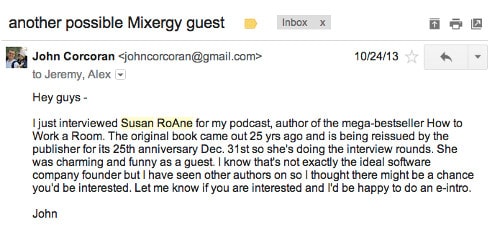
So here was my email to Andrew and his team:
I turns out my instincts were right on. Not only had Andrew read Susan’s book, but it turns out he was a big fan.
I immediately did an introduction:
As you can see, I kept the introduction short and made it a little lighthearted.
AoM’s
own resident style guru is another expert in the art of the gentlemanly
virtual introduction. I wouldn’t be writing for AoM if I hadn’t been
the beneficiary of Antonio introducing me to Brett and Kate. Here’s
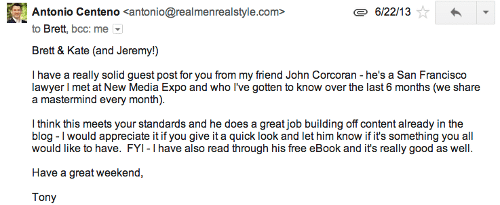
Antonio’s original email:
Antonio’s
email was short, to the point, and relevant. He even went the extra
step of reporting that he had read through my free ebook and that it was
of high quality. That’s why it was a well-executed introduction.
Step 5: Follow Up Later
Finally,
follow up with the people you introduce a few weeks or months later to
be sure they connected. Oftentimes people get busy and they simply
forget to follow through on the introduction you made.
Introductions may simply get lost, or overlooked. That’s why it’s best to have a system for tracking the introductions you do.
I use a free tool called
Intros.to which allows you to track your own introductions when you introduce two people via email. You can simply bcc
Intros.to,
and the system will track your introductions. It can also send you
reminders to follow up with people who you introduced previously.
Get Started Making Introductions Today
When
it comes to making introductions, you have to play the long game. You
can’t expect introductions to immediately turn into money in your
pocket. As both Walsh and Johnson demonstrated, introductions will pay
off if you do it consistently.
If
I look back at my career, nearly every job I ever had came thanks to an
introduction. From waiting tables at a BBQ restaurant during high
school to working at the White House, someone stuck their neck out for
me and introduced me. Even today, the majority of my clients come via an
introduction from a mutual acquaintance or friend.
That’s
why I believe giving back by making introductions is so important. Not
simply because it is financially rewarding for all involved, but because
a small investment of your time can make a massive difference.
Your introduction can literally alter the course of a person’s life.
Remember John and Dotty, the couple that Pat Walsh introduced who later got married? Curious if the marriage worked out?
Turns out it worked quite well. John and Dotty have been married for 43 years.
How do I know?
They’re my parents.
Here they are, after 43 years of marriage, with my son, Mason, who was their first grandson:
I
wouldn’t be here today if Pat Walsh hadn’t taken the time to make an
introduction. Mason wouldn’t be here today if Pat Walsh hadn’t made that
introduction.
We’re both testaments to the power of introductions.
Thanks, Pat.
Who in your network are you going to introduce today? Let us know in the comments below.
_________________________________________________
Editor’s
note: We’d like like to welcome John as AoM’s newest regular
contributor! He’s been sending in guest posts every month for awhile and
now we’re just making it official. Each month John will be sharing his
great tips on how to socialize confidently and network professionally.
Welcome aboard John — we love having you on the team! And thanks for the
introduction, Antonio!
I highly recommend John's e-book, as well as trying out
intros.to so you can better track, and follow-up with, your intros.
Interesting days
Tomorrow -
Endangered Species Day,
Bike To Work Day,
Pizza Party Day and May Ray Day
Next Thursday-
Wine Day,
Tap Dance Day,
Geek Pride Day and
Towel Day
June 18 - Is it any coincidence that
Go Fishing Day and
International Sushi Day are both on the same day? Although it's probably not good to combine either of these two with
Clean Your Aquarium Day. How about making that fishing sushi trip into a picnic, since it's also
International Picnic Day. It's also
Turkey Lovers' Day,
Splurge Day and
International Yoga Day. With so many things to celebrate, you just might forget to celebrate
International Panic Day!


 Posts
Posts